
A Closer Look into Shaman I: The Universal Translator

By: Caroline Frisby and Angelina Kondrat
The river gurgled as the Ranger treaded through the shallow water. On the other side, the riverbed sloshed underneath his boots. He straightened his hat as he squinted at his GPS, verifying his exact location. Continuing his route, he trudged uphill, eyes and ears vigilant to the sounds of the wild in the Osa Peninsula of southwestern Costa Rica.
After a few moments' climb, he heard a thunderous BANG followed by startled screeching. He felt a jolting sensation in his chest and scrambled down the slope. When he made it into the clearing, he saw something shiny glare up at him from the ground. He turned it over in his hand, and it was a shell casing.
As the Ranger demonstrated, traditional monitoring methods such as on-the-ground patrols and camera traps struggle to deter poaching in difficult terrain. The rainforest is a challenging environment to monitor on foot, with muddy streams, uneven trails, and thick undergrowth. River crossings can be dangerous because they may have sinking mud and fast currents. Trails may be muddy and slippery, with fallen trees and exposed roots. It’s also easy to become lost because trails are often unmarked. Dense foliage may block sunlight, making the trails dark. Current forms of technology face similar setbacks. Thick canopies block drone signals and limit visibility. Camera traps can only capture close-range activity, while rainfall, high humidity, and extreme heat further complicate efforts.
These challenges led Princess Aliyah Pandolfi, founder of Kashmir World Foundation (KwF), to rethink anti-poaching technology for the complex rainforest environment. Drones were not practical, so Pandolfi had the idea to leverage BioAcoustics, the study of sound, and conduct analyses with AI. Inspired by a Star Trek device that could translate alien languages in real time, she named her invention the Universal Translator for Sentinel Species (UTSS). Another catalyst that sparked this project was her daughter Kashmir’s multi-modal Chick-Check App, which differentiates between male and female chicks based on behavioral cues.
Pandolfi began planning for KwF to launch a project that can monitor the rainforest’s soundscape for vocal cues from sentinel species. These animals are susceptible to environmental changes and are widely understood by other species.

The uniqueness of sentinel species' vocalizations lies not just in the specific sounds they make, but in how these sounds function as early warning systems. As with humans, Studies have shown that when afraid, the tone and vibrations of human voices are the same, regardless of their language or dialect. This same principle applies to sentinel species. Although their signals warn other animals that danger is approaching, multiple scenarios would prompt these vocalizations, including the presence of a predator, defending their territory, and, of course, poaching and illegal logging. Therefore, the device must be able to distinguish between what dangers prompted their vocalizations. Not only will this fast-action and alert system lay the foundation for the future of conservation in threatened ecosystems, but it can also be useful in domestic environments. Pandolfi added, “It could definitely be used for people with their own flock of sheep, goats, herd, or whatever it is.”
In September, Pandolfi reached out to Dominic Hoff, who had begun working with Kashmir World Foundation’s Aerospace Engineering Team Pegasus in the spring. Recognizing his enthusiasm and leadership potential, she offered him the opportunity to serve as Team Lead for a newly formed Mechatronics Team. Hoff was enthusiastic about the project and proposed the name Shaman I, inspired by the concept of the “medicine man.” According to PBS, shamanism is one of the oldest traditions in human history. In many cultures, shamans serve as mediators between the physical and spiritual worlds, often seeking guidance from spirits, healing individuals, and foretelling the future. In modern societies, they symbolize spiritual harmony, wisdom, and interconnectedness. Led by Hoff and supported by interns Sean Liu, Ryu Brandt, Kyle Saiki, and Jannuel “Ylo” Lauro T. Dizon, the Universal Translator is a bold project that combines technology, ecology, and real-world field expertise to detect poachers early and provide rangers with actionable information.

As the visionary, Pandolfi sees the Universal Translator as a sentinel for the environment. “This system we're developing has the potential to process a wide range of information from sound and vision to temperature, moisture, and weather variations in real time,” she explains. In doing so, Shaman I can detect and analyze threats much like a person might—pausing, retreating, or fleeing when something feels wrong. To illustrate the concept, Pandolfi offers a thought experiment: “Imagine you are walking alone along a quiet, dimly lit trail, and you hear someone moving behind you. What would you do? Do you run? Do you pause and turn around to check? Or do you call someone for help?”
Due to its complexity, it is essential to carefully identify and address any potential flaws in the project. If the device processes information too quickly, it may overlook subtle but critical details; if it processes information too slowly, preventative reactions might come too late. For this reason, the team is reevaluating the system requirements. Pandolfi notes, “We are still determining the computational requirements needed to process the AI data from audio, video, and other environmental sensors in real time.”
Although the system is still in its early stages, it will likely include microphones, microprocessors, batteries, motion sensors, and wireless modules. Additional sensors may be added to help the devices withstand harsh environmental conditions. However, the real innovation lies in its mesh communication network, which allows devices to relay information to rangers without relying on cell towers. Hoff explains, “Each device connects directly to others in the network. If one node goes offline, another takes over. This redundancy keeps the system running even in tough terrain.” Because the ultimate goal is to deploy Shaman I in multiple areas around the world, the team is ensuring that these modules use accessible, cost-effective technology. It’s a collaborative effort that draws on expertise across KwF.
Hoff points out that once the prototype is built, parts can be reused across multiple units, reducing future costs. It will also be tested in various locations. “Real-world testing is crucial,” Hoff notes. “We need to see how sound travels, how power is consumed, and how data reliably reaches rangers even in extreme conditions.”

One testing location will be KwF’s new headquarters, which is a mountainous property in Arkansas called, “The Montevia Sky Ranch.” Mechatronics Team Member Kyle Saiki will also be testing a prototype in the Redwood Forest near Santa Cruz, CA, where he resides. Pandolfi noted that their goal is to reach out to university students worldwide and set up programs to teach them how to build the Universal Translator.
She says, “It's not just about developing a product. I want to teach people how to build the system in the field and repair it if issues arise. Partnering with universities around the world for hands-on learning, testing, and data collection would be an incredible opportunity for educators, students, and our team. Students would gain practical experience with hardware, software, and system deployment, while also learning about conservation. By sharing their results with us, we can collaborate globally and combine knowledge to advance both education and environmental impact.”
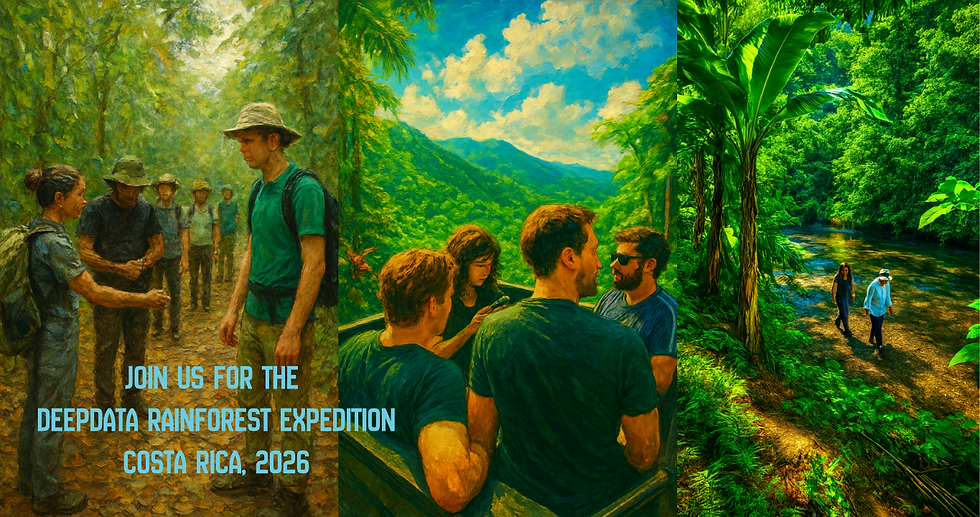
The Shaman I team is already planning to expand testing in Costa Rica during their next visit, scheduled for May 25–29, 2026. Future tests will focus on enhancing data collection through simulations with more realistic sound stimuli and deploying additional devices in new areas. Pandolfi is also eager to expand KwF partnerships. She reflects, “One thing I’ve learned working on projects around the world is that I want to involve the government only at the very end. That’s why this partnership with Rebeca Quiros, a Tropical Biologist and owner of the Tamandua Biological Station, is so perfect. She’s as passionate as I am about protecting the species there. Because Tamandua is a private Biological Station, we have our own playground—a test lab in the wild. It’s right in the Osa Peninsula, bordering Corcovado National Park. I feel that without this partnership, we could not have moved the project as quickly as we have. It’s only because Rebeca has been so open to my ‘crazy’ ideas.”
For Hoff, his team’s goal is “to create a resilient, effective, and scalable tool that empowers rangers and protects wildlife. This project combines practical engineering with real-world conservation impact, and we’re just getting started.” For Pandolfi, the Universal Translator is her key to shaping the future of conservation, one student at a time. “Our goal is to expand globally, and the best way to do this is to collaborate with where the future is, and that’s students. Universities are ideal partners because... each new group of students engages with the project, gains hands-on experience, and contributes to its continued development.”


Comments